Saturday, December 15, 2012

What can I say to my students?

I cannot stop thinking about the families, teachers, students and all the townspeople of Newtown, CT.  There can be no justice, no meaning made.

Now the question that wakes me: What can I say to my students?

Death is not unfamiliar to most of them.  One eighth grade student just uncovered his brother's dead body in bed last month after a drug overdose.  He was absent for three or four days, and when he returned he was eerily "normal," just a bit hyper-focused on his work.  As the weeks have passed, Dylan's grip on himself has continued to slip.  He cannot sit still.  He runs and jumps into the reading corner bean bag chairs, throwing a pink one overhead while the rest of the students looked on from their group work, annoyed.  I've been quietly reminding them to be patient with him, but how can they fully understand his grief?  How can I gently help him cope in class, beyond linking him with the appropriate trained psychologists and counselors outside of my classroom?

So many students, so much pain.  Some are not very well cared for, in dirty clothes, with unwashed hair and darting eyes.  So many in foster care or living with aunties and grandparents.

And now this.

How will I start the conversation in a way that is sensitive, gentle, productive, healthy?  How else would an ELA teacher proceed?  Books.

A professor of mine at the University of Kentucky's Library and Information Science program introduced me to the field of bibliotherapy.  Books can help start healing conversations with students, as well as help them cope with the myriad issues with which they struggle.  One caveat though, exemplified in the case of my student Dylan, is that the student must be ready to cope with the issue.  If not, they might react negatively to the book I give them, as it might force them to acknowledge a pain they're avoiding.

Still, for tragic events that affect all of us, I think it's important to start the conversation, because the kids are going to have a lot of questions.  One blogger who has been through tragedies with her students, including witnessing a suicide and 9/11, writes of success using Charlotte's Web with her kindergartners to help them cope with these tragedies.

Of course my early adolescents need something with more grit.  I found a list of school shooting books on GoodReads, and I just ordered Columbine by Dave Cullen and Shooter by Walter Dean Myers from the local public library.  I'll share this student review of Teen Ink, and when I go pick the books up form the library, I'll ask for picture books about grief to start the conversation.


After a tragedy like this, my first thought is, how can I help my students?  My second thought is how can we, as a society and as teachers, prevent such tragedies from recurring?  While some make the case for the rarity of mass public shooting, that it happens at all should be an impetus for prevention.

William Glaverson of the New York Times writes an important piece on the difficult questions we ask after such a tragedy.  Apparently, in all or most of the public massacres in the last twenty years, the mad men (and they have nearly all been men, and all mentally ill) have made numerous "cries for help" before they committed their murders.  I believe the social stigmatization of mental illness, particularly for men in our nation, is partly to blame.  If only they could receive mental health treatment as easily as they could acquire automatic weapons.

On the front end, teachers and adults in the community can and should do more to support the emotional well being of all their students.  It is easy to ignore the loners, the boys who eat lunch alone, who face ridicule, who are unwell, especially if they don't cause class disruptions.  We must take the time to reach out to them, to their parents, and to get them the mental health services they may need early, before more fall victim to the violent expression of pain endured to the breaking point of the mentally ill.

What can I say to my students?  How about, "Are you okay?"


Sunday, December 9, 2012

Common Core Help

Because Kentucky was the first state to roll out (and assess at all grade levels, yikes!) the new Common Core State Standards, Kentucky teachers are hip to the shifts and challenges of implementing these more rigorous standards.  After a year and a half of working with them, I definitely believe they will improve public education.

For one of my library science classes I created a pathfinder -- an electronic research assistant. I created this one on Google Sites to assist K-12 classroom teachers seeking information on the new common core state standards.  It's a great resource for anyone who has questions about the standards and how to implement them.

Thursday, December 6, 2012

Words that are Worth their Weight

One thing I love about teaching, is how you get to start fresh each August and revise the work of the year before.  This year, I took my old idea of an interactive word wall (credit to Janet Allen, of course!), and revised it to include the three tiers of vocabulary instruction.

Tier 1 Vocabulary
Tier 1 words are basic, common sight words.  Simple, single-meaning words like "good" or "dog" or "sad" or "sit." Dr. Seussy words that are critical vocabulary for younger students and emerging readers. For middle school students, however, Tier 1 words make for pretty lousy writing.  Thus, the Tier 1 words have become our "'Bad' Words." 

Tier 1 Vocabulary
Early in the year, we discuss what makes precise writing. As kids use "he" or "it" vaguely, I redirect them to be more specific about who or what they're writing or talking about. They "find a better word" and hang the "bad word" on the wall for future reference. From there, they love to listen for bad words and help keep each other (and me!) precise and clear.

Tier 2 Vocabulary
These words are part of the general academic language that opens doors for students.  I used to call them SAT words when I was their age.  Since the student population I teach isn't as obsessed with the SAT as we preppy little Catholic school students were, I now call them "Money Words" in my classroom.  These words are "rich," in that they are specific and enrich writing.  They're also "five-dollar words," and most importantly, they are the words the acquisition of which will provide my students with better, more lucrative opportunities. 

Tier 2 Vocabulary
These are words my students find in their reading throughout the year.  When they don't know the meaning of a word, they use context clues, roots, the dictionary and me to access the meaning of the word.  As they learn new, more precise, rich words, they write them on these sticky sentence strips and post them on our word wall.  Students enjoy the kinesthetic aspect of this routine, and they compete to see who can post the most Money Words.  Not only do they enjoy adding to the word wall, they also refer to it as they write to get ideas and inspiration to enliven their word choice.

Tier 3 Vocabulary
These are domain-specific words.  So, in biology "mitosis" and "nucleus," and in math "slope" and "algorithm."  These words aren't widely used and don't necessarily provide much capital beyond their field.  Tier 3 words are still important to each content area, however, for accessing, processing, understanding, discussing and reflecting on the content.

Tier 3 Vocabulary
As we learn literary terms, literacy skills, or discuss unfamiliar terminology of the study of English language arts, students write down the words and post them for later reference and review. 

Tier 3 used to be the main focus of ELA vocabulary instruction.  With the new Common Core Standards, however, has come vocabulary revolution.  The Common Core shifts in ELA and math are pushing instruction to more rigorous realms.  Where we used to teach domain-specific vocabulary nearly exclusively, we now teach students to mine complex texts for rich, multi-layered academic language.  The emphasis on the subtleties and the multi-faceted, organic nature of language pushes students beyond the rote memorization of words like "metaphor" and "synecdoche" to understanding the ways in which authors use words to play with language and make deep, real meaning. 

The shift from Tier 3 to Tier 2 is so much more than new vocabulary lists.  It's a move BEYOND vocabulary lists to deep analysis and acquisition of powerful words that can empower students.

Tuesday, November 27, 2012

Don't Hesitate...Annotate!

It's been a minute since I've written, but I'm excited to be back and ready to share my lesson plans, ideas, student work and general musings. So get ready!

This year has been an exciting change. I'm back to work full time after taking a year "off" at half-time teaching and going to school to pursue my Masters in Library and Information Science at the University of Kentucky.  I'm now teaching two class of eighth grade ELA, taking my last two MLIS courses, and serving as the literacy resource lead for my school.  So I've got a bit on my plate, but I wouldn't have it any other way!

Westport Middle School, where I teach, is an amazing place. The faculty is inspiring, talented and hard working. The culture is positive, inclusive and student-oriented. But we certainly have our challenges - 70% of our kids qualify for government-subsidized lunches. Many of our most disadvantaged kids are bussed thirty minutes each way, which makes it difficult for parents who may not have easy access to transportation to get to the school to get involved under either negative or positive circumstances. We deal with the many issues that plague kids in poverty every day. But our school is changing.

Thus far, the data have not given testament to our hard work and the softer gains we "feel" we've made.  Here in Kentucky, we were the first to roll out the new Common Core State Standards last year. All students were tested on the CCSS last year with a test created by Pearson called the KPREP. When the scores came out last month, we were definitely disappointed. After a brief dip into dispair, we pulled ourselves up by the proverbial bootstraps and began to recallibrate.
  • Positive school culture? Check.
  • Committed and skilled faculty? Check.
  • Supportive and encouraging leadership? Check
All these items were in place last year.  At the beginning of this year, we'd installed a few more necessary systems and structures.
So what were we lacking?  (For one, a highly refined and functional RtI system, but we're still working on that.) One thought kept plaguing me: the kids can't read.  What could I do in my role as half-time literacy resource to really affect change?  What could be done school-wide that would be effective and garner teacher buy in?

Why, annotation, of course!


Earlier in the year, my colleague Jenny Napier suggest having the 8th graders read and annotate Kelly Gallagher's Article of the Week.  While not every kid turned in their homework (shocker!), many were starting to get the hang of annotating to record their thinking.  We encouraged kids to annotate everything we read in language arts: to circle unknown words, to underline and star important ideas, to mark confusing parts with a question mark, and to write notes in the margins.

Kelly Gallagher's Articles of the Week

We realized many of our kids were sitting quietly at their desks, not causing any problems to get attention, and....not reading.  Annoatation actually forced them to engage with a text in a meaningful way, record their thinking so that in two seconds I could see if they were actually reading or not.

I wondered if the problem of passive non-reading was endemic or school wide?  Was the problem that our many kids who came to us below grade level in sixth grade were continuing to fall farther and farther behind because they simply were not reading??

In several classrooms I visited I saw the same things: teachers reading difficult texts aloud.  And many kids listening...but not reading.  By not having time to struggle with texts, kids weren't getting the experiences they needed to build reading stamina and confidence.  The first difficult texts they were given to read individually all last year may have even been the KPREP texts!  No wonder we didn't soar.

So, with the blessing of my esteemed principal, Dr. Staci Eddleman, we rolled out our first school-wide literacy initiative: ANNOTATION.

Teachers were encouraged to give kids time to struggle with difficult texts on their own first, and then to support them. 

Kids were required to annotate EVERY text they read, in every single subject from math to the humanities.  Different subjects taught annotation differently, but the main thing was everybody got on board. 

And the kids....hated it.  But they hate broccoli too, right?


How to annotate word problems in math class

Annotating in science

Student annotations decorate the halls at Westport
And we've begun to see results. In my PLC alone, our diagnostic index was around 50% proficiency last September.  We set our SMART goal at 75% and just got our results - each of the five teachers met or exceeded our goal, a success we attribute simply to requiring our students to annotate.

Thursday, October 27, 2011

Who are we fighting for?

In my casual research tonight on the Occupy Wall Street movement, I came across this video, called "Occupy the Department Of Education":


I was really surprised. The Common Core Standards are, in my humble opinion, probably the best federal initiative for public education since I've started teaching, and maybe even ever. They are clear, measurable, rigorous and allow teachers plenty of creative freedom in the classroom. But then, was this demonstration really about the standards? I could see PTA members troubled over New York City's questionable recent history with public education. Mayor Bloomberg took over the schools and made miraculous gains by lowering the standards. But now the Common Core will raise them. Are people angry because they worry their kids might not meet the standards after years of low standards and be held back, as is the practice in New York? Or are they just angry they didn't have a say in whether or not the standards were adopted?

It's clear that many people, both on the left and on the right, currently feel alienated from their local, state and federal governments. I also came across this image tonight, which I thought was interesting. (And, as a teacher, I love Venn Diagrams!)


I guess my main concern from watching the Occupy DOE video is that I don't want the tone in this country to turn so combative, so "people" vs. "the man" that we throw out the proverbial baby with the bathwater. I don't want to see systems that can work abandoned because people feel disempowered (i.e., public education as the enemy.) When really, low standards for public school students is what we should be fighting.

Saturday, October 22, 2011

Apps, Apps, Apps!

An amazing presentation at the LWP Technology Conference on Sunday by Amy Vujaklija enlightened me to a number of amazing smart phone applications that can be utilized in the classroom.


Common Core

View the standards for math and literacy by grade level - no more lugging around heavy and cumbersome binders!


GoodReads and GoodReads BookScanner

Check your students' comments and track their reviews with GoodReads' App, and scan the barcode of any book to read the GoodReads review. Great for book talks!


Home Library

Scan in your classroom library and keep track of all your titles and their costs. You can actually check books out to your students on your iPhone, so you'll know who's reading what at all times, and be able to decrease the number of "lost" books, or even hold students accountable. You can even send them a friendly reminder about the book right from this application!


TeacherPal

A personal organizer for teachers. You can track attendance, grades and behavior. It creates data you can share with students, parents and administrators to make sure all kids are successful.


Edmodo

A way to stay connected with students. Send notes, reminders about homework or assignments due, be accessible to your students for homework questions.


Dragon Dictation

Great for special needs students who have "scribe" as an accommodation on their IEP. Students can dictate their writing, and the application records it as they speak. Unfortunately, the only way to punctuate is to manually add periods, commas or other punctuation.


Dictionary.com

A great ap for teachers and students for building vocabulary. The word of the day is an added bonus!

Sunday, September 11, 2011

The More Lived-In Classroom

When I was first becoming a teacher - that short summer of education classes before I entered my baptismal flames - and we were reading Janet Allen's Words, Words, Words, I couldn't fathom what a "Word Wall" was actually good for. Since then, my uses and adaptations of the instructional strategy have changed many times. Some uses are documented on this blog, but each year I make new decisions and innovations. Here are the ways I'm using my Word Wall this year to help my students improve their vocabulary.


The so-called "Highfallutin Words" are words that are not in my students normal vernacular, but they are the words found in the new common core state standards, as well as what will no doubt appear on the standardized tests policy makers are busily hammering out. One of our first learning targets was "I can distinguish between connotation and denotation." Here you can see the words and definitions two students wrote and hung on the word wall.

Next to the Highfallutin words, are the "Spicy Words." These are possible replacement synonyms for dull and boring words my students may commonly use in their writing. These words came from a word sort activity on tone (related to connotation and denotation.) We'll use this section of the word wall to a greater extent when we write our first piece on heroism.


Finally, we have the "Bad Words." Because of our code-switching lessons, my students know that these aren't really "bad" words; just words that aren't appropriate for the language arts classroom. They're informal words better suited for texting or casual speech with friends and family.


In addition to the word wall, evidence of my students' presence can be seen on the chalk board I'd once envisioned to be my timer wall. Now, it's a place for students to claim the lost articles middle schoolers are so apt to forget: books, nameless papers, agenda planners, notebooks and the like. You can also see evidence of our classroom structure: we had to revisit expectations last week and it had a positive affect on the classroom climate. When the kids know exactly what's expected of them, it's much easier to maintain a calm and safe environment, even when hormones are raging.

Monday, September 5, 2011

Social Networking with Students

A few years ago I used GoodReads.com as an enrichment with my students. Back then I had computers in my classroom, and I allowed the kids to get online when they finished their work. Now, sans computers, I'm using GoodReads again - this time in place of those old, raggedy paper reading logs. No more strangely coincidental documentation! ("Danny, I see you read ten pages every night from 9:00 to 9:30...again.") No more forged signatures! No more "lost papers" turned in on the last day of the grading period filled out the night before!* (*For students who don't have computer or Internet access, or whose parents don't want them online, of whom there are only a few, the raggedy paper logs remain...)

GoodReads allows for an authentic discussion about books. Students are familiar with social networking due to the countless hours they spend each night on FaceBook. Now, their homework is more fun and engaging because it's conversational, interactive and technological.


Students add books to shelves that I and their friends can see: "currently reading," "read" and "to read." The books appear with their covers, and students can rate the books with one to five stars. They can also write reviews and read each others, which gives them a good idea of what books are out there, and what might interest them. It also gets them excited about reading and makes it a bit more "cool," since it gives reading a social element, rather than remaining a solitary activity.

At the beginning of the year I created class groups for each of my class periods. The students first assignment was to create an account and join their respective group.


Their second assignment - and all subsequent weekly homework - is to respond to a discussion prompt on their group's wall. Each Wednesday I post a discussion topic, and they have to reply by Friday at midnight for full credit.


The discussion so far has been pretty simple: what book are you reading, if you abandoned a book tell us why, how much have you read this week, make a text-to-text, -self, or -world connection to your book, summarize what has happened, etc. After my students are more in the habit of using GoodReads and posting on time, I plan to take the questions a bit deeper. For now, it seems to be accomplishing its goal of getting them READING - and that's what's most important.

Wednesday, August 31, 2011

Classroom Set Up

It's a new school year, and as always the summer has refreshed me and left me excited and ready for the new school year. You might think I'd be sad about have to down-size my room space, but I'm actually thrilled about my new room! My former room was almost too much space - sounds strange, I know, how could there be too much space? But somehow it made it seem like I was farther away from my students and in that way made it more challenging to manage.

I absolutely love my classroom this year! I think it's my best room design yet. Here are some of the photos I shot before the kiddos arrived; it looks a little more "lived in" two weeks into school.


My classroom library with books arranged by genre/reading interest.


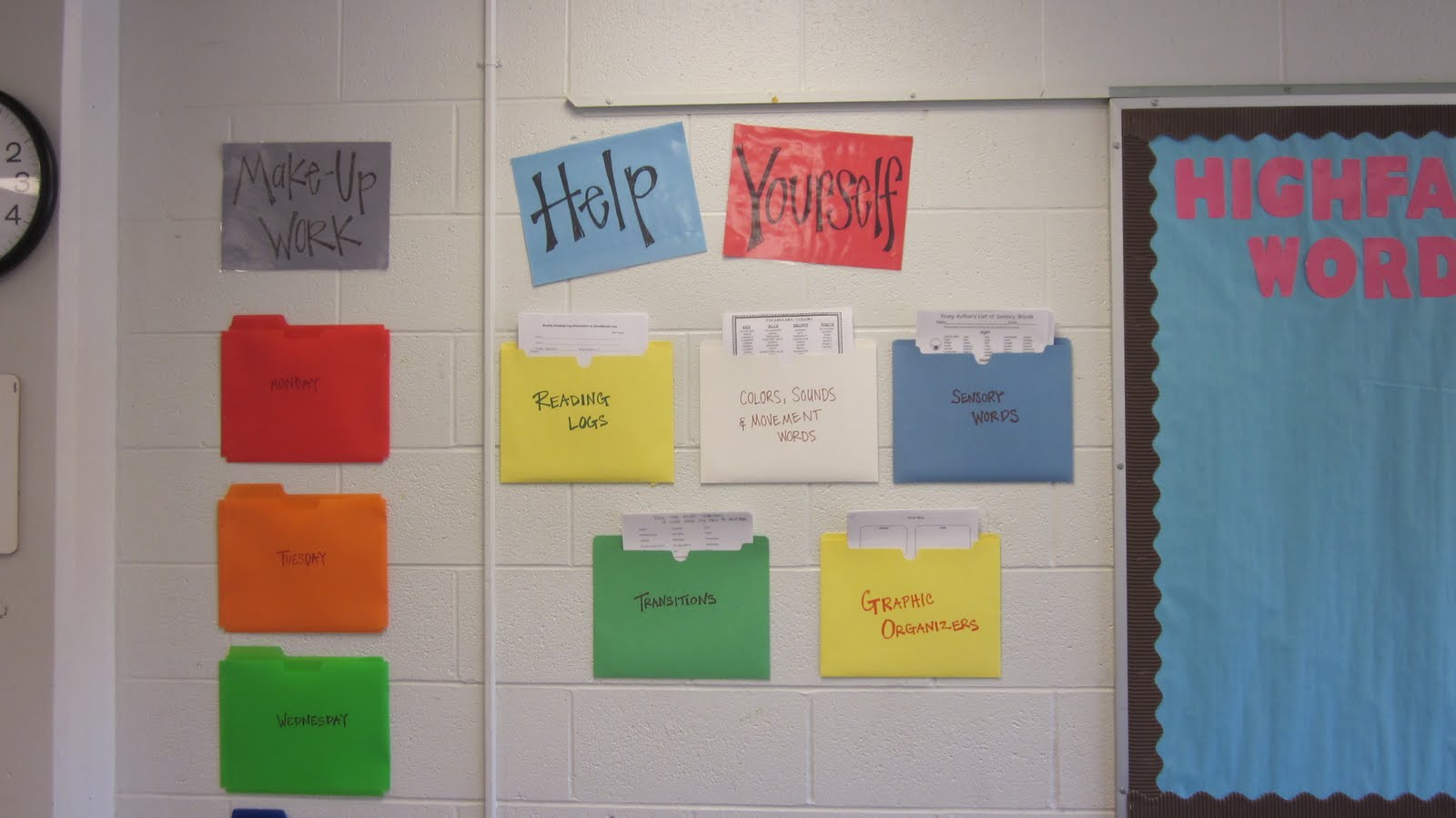
Make-up work wall, where students can get the hand-outs and information about the previous days' lessons.


Our student work books and some writer's notebooks - still waiting for the rest to come in!


Bookmarks for students.


Student writing folders.


Sticky note sentence strips. Students will write words for the word wall on these. Although I hadn't realized it when I set up my room, this has since become my "Is It Yours?" spot where students can reclaim lost materials or no-name papers.

"Take a Break" chair, where students go when they need to refocus. They can go of their own volition or when I ask them to, but it's not a punishment; just a place for them to re-center.


Reading Corner for when students finish classwork.


Quote of the week and the week's plan posted here.


Student desks are arranged in groups of four with one remainder group of two.


I post student jobs, the unit's essential questions, the date (and Happy Birthday messages), learning targets and the agenda here.


"Help Yourself" wall where students can take regular hand-outs or resources to help them improve their writing.


Place to display exceptional student work, a place where students can get resources on how to publish their work, and an "About You" wall where students will decorate the bulletin board with pictures that show us who they are - like a show and tell. I did the first one with pictures from my life and my eighth grade report card that my mom had stored in her basement. The kids always ask, "Ms. Yost, how could you get a C in gym?" *Sigh* Memories of falling off monkey bars and walking the mile...


My desk with pictures and artwork of former students behind me.


Word Wall: "Highfalutin Words" (or academic words that students may not be familiar with), "Spicy Words" (or precise words that could improve our writing), and "Bad Words" (or informal words and trendy spellings that students may use casually, but that aren't appropriate for formal writing.)


Wednesday, August 10, 2011

New Common Core Standards: *Gulp!*

Our first day is tomorrow, though the kiddos don't return until Monday. We're scrambling with paper and bordette and little cut out letters and glitter and rosters and name tags and...what's this? New Common Core Standards?! Kentucky, like forty-six other states, adopted these national standards in an effort to win Obama and Duncan's Race to the Top. While Kentucky was not successful in this aim, we still won a great opportunity to completely overhall our instruction in English language arts and math.

I was fortunate to have worked with the new standards last school year and during the summer for the Gates Foundation's Common Core Curriculum Mapping Project. I created a curriculum module for writing monologues aligned with the standards. More important than this prestious opportunity was the chance to "get my hands dirty" so to speak, and really dive into the standards. While they are impressively rigorous (sixth graders are now to type three pages in one class sitting, for example), they are also clear and well organized, and will make standards-based grading, data driven instruction and alignment of learning targets with assessment much easier. They also bring reading and writing accountability into the science and social studies classrooms, which will reinforce the notion that the strongest teachers already believed - literacy underlies success in all text-based content areas.

The curriculum I followed last year and will follow again this year is the College Board's SpringBoard program for middle and high school students.

The SpringBoard program is already aligned with the common core, though I didn't realize the standards alignment was accessible online. No, instead I thought it would be a good idea to spend four hours mapping the first unit of instruction in alignment with the new common core; still I'm glad I did as it prepared me for the instruction.

After mapping out the curriculum, my colleague and collaborator, Ms. W, and I planned two ways to pre-assess the students initially. First in literary reading, then in language, or grammar. We would administer a reading test to them with questions directly aligned with the literary reading standards and use a checklist to identify whether students were demonstrating, developing, or not demonstrating the skill. Likewise, with the language standards, we developed a checklist and plan to use analyses of their writing to determine whether or not they've mastered the skills.

Because the pre-assessment contains some copyrighted material, I'll just share the checklists here.

Language Standards Checklist

Literature Reading Standards Checklist

Armed with hard copies of the standards, web resources, plans, pre-assessments and these checklists, I'm hopeful that these new standards will prove as an opportunity to radically improve and tighten my instruction. I'll let you know how it goes!

Power at Our Fingertips: Google Docs in the Classroom

For one of my classes this summer, I had to research and present on a technology that could be used to enhance instruction. Google Doces has so many applications for language arts and other content areas - check out Google for Educators for some amazing ideas.

Here is the PowerPoint for my presentation; ironically not created in Google Docs. (I suppose because this was a solo project and not a collab.)

YostS_TechnologyPaper.presentation.powerPoint - Copy

In another class, I did a lot of work with Google Docs myself. The work included creating a project proposal in collaboration with other people in the class, creating a survey, documenting the results, and creating a presentation of the survey results and our analysis. This inspired me to begin this year by keeping track of student data with a Google Docs spread sheet. I have very little experience with Excel to begin with, so I'm sure the learning curve will be sharp. Still, I think the technology will help me stay organized, and with only two classes of students this year while I work on my MS LIS, it will be the perfect time to experiement.

Thursday, July 28, 2011

Reflection on LIS636: Foundations of Information Technology

Some readers may be aware that I've begun my masters of library science for school media specialist certification at the University of Kentucky through their distance learning program. As a final assignment to an introductory technology course, my instructor asked us to present a reflection on our relationship to technology in some technologically interesting form. Naturally, I thought of The Mighty Pencil. Below are my reflections on the course projects and their classroom implications.

As this course draws to a close, I am struck by the breadth of what we learned about information technology, and the implications for professional use in my classroom this year and a school media center some day. I came into the course intimidated and unsure of what to expect, but as the course progressed, I realized I had steadier footing than I had thought in the way of technology. Still, it was nice to learn the "nuts and bolts" of computers, the history of information technology, and the language of code - both binary and html. Overall, I have found this class quite interesting, and I feel much better informed now, and thereby more empowered when it comes to utilizing all that technology has to offer me and my students.

Undoubtedly the most difficult assignment this summer was project three, for which we had to write html code that included links and an image. Sounds simple, right? That's what I thought too, until I got started. Although I nearly smashed my computer at one point (kidding), I definitely appreciated the challenging process of learning - I don't think I could have learned it more thoroughly had I been given the exact steps of the process. It was truly valuable to "play" (although "play" has far too light and positive a connotation) with the code and muddle through until I at last uncovered the appropriate paths. And when I did this website is what I developed - try to contain your supreme awe at the complexity of the design (kidding again - it's quite rustic.)

While project three may have been the most trying, our experience with Google Docs was by far the most valuable. After our collaboration project opened my eyes to the powers of cloud computing with Google software, I grew fascinated by the technology, and decided to do my final project for my other class, Current Trends in School Media, on the use of Google Docs in the classroom. I am more than a little inspired at the capacity of this software to transform instruction, particularly ELA writing instruction, in terms of collaboration and assessment. I especially like the archiving of former drafts, which can allow writing teachers to assess the progression of a writing piece through revision - something that has always been messy and cumbersome. And, as an eco-freak, I am absolutely smitten with the reduction of paper waste. Were it not for this course, I would still be very much in the dark about all that Google Docs has to offer.


Another project I really enjoyed was the creation of our websites on Google. It was a fun to create the website and imagine its potential, while getting to know our classmates far better than we could have in a regular distance learning course. Of course I saw great potential for Google's sites feature in the classroom. When my principal asked me to head the literary journal this year at Westport, I immediately thought of Google Sites as a publishing option for an online literary journal. It would be easy, green and exciting for students to get their work up and out there for the world to read. I really can't wait to get started with it, and promise to post links as my students start creating something interesting.

Aside from the immediately pragmatic benefits of this course, what I've found most valuable is the confidence that I've gained. I like knowing that RAM is Random Access Memory, that it's the "short term" memory your computer uses to operate open programs in one sitting, and that it's impermance is the reason why my student lost his writing piece when a prankster friend unplugged his computer mid-keystroke. I like knowing that cookies may have been so named for the cookie crumb trail of data they leave on your hard drive, letting advertisers know where you've been online. I like knowing that binary is computer language (even if I could never read it) and html is the language of computer programmers. I like knowing these things because it makes me feel more empowered. Now I'm more likely to click around on the computer, exploring ways to do what I want to do more efficiently, rather than just calling over my more tech-savvy husband. This sense of confidence and empowerment is one I hope to share with students as an ELA teacher this year and someday as a librarian.

Friday, July 15, 2011

WebQuest

I know I haven't been on to blog in a while, I'm ashamed to say, but a new embarkation has left me inspired. I'm currently working toward an MS of Library and Information Science at the University of Kentucky with the hope of moving into school media in two years. The more I learn about school media and library science in the program, the more confident I feel that this is the right move for me to make.

One of my first projects has been to create a WebQuest on QuestGarden. Initial thought: WebQuests are awesome. They are great ways to scaffold research projects for your kiddos, and although they take a bit more time on the front end, they will no doubt cut down on a lot of stress during the unit. I plan on sharing this "Civil War Letters" WebQuest with the social studies teacher on my team.

The first month is free and you can create and save as many WebQuests as you like. You can also publish your WebQuests for that month (see mine above), but after that a paid subscription is needed to continue accessing your WebQuest. I'm going to ask for that straight away, because I can see this being a great year-long and beyond resource.

Sunday, August 22, 2010

Day Three: The Letter of Introduction

At the beginning of each year, I write my students a letter welcoming to my class and setting a positive, learning-focused tone. Then I have them write back to me, discussing who they are as readers and writers.

Here is my letter:

Letter of Introduction

From their letters, I begin to build rapport and gather data for the grammar and mechanics lessons that will need to be taught throughout the year. I build rapport by commenting on each of their papers, relating and responding to what they have to say. I do not "correct" any of their mechanics mistakes, but instead create a matrix of all the errors I mine. That way, I can later confer with the students about their growth areas and plan my lessons to meet my students' needs.

Here is the mechanics matrix I created:

Class Mechanics Matrices

Day Two: The Syllabus

On the second day, I discuss the syllabus in depth with my students. Here's what I have planned for the year:

Syllabus 10 11

Day One Plans: Routines and Procedures

Ah, housekeeping the first week. It's so critical that I set up my systems, help the kids get all their supplies organized, and really lay the foundation for how I want them to behave in my classroom early on, because as the year goes on I get more and more tired, and I really rely on these systems to keep my classroom running smoothly.

If I don't lay the foundation, we'll never be able to build the house, so to speak. We won't be able to do cooperative learning and writer's workshop, if my expectations, routines and organization isn't clear. Thus, first week housekeeping.

Here is the PowerPoint I use to introduce my classroom expectations:

First Week Classroom Expectations

The "Resilency" link took the kids to the following motivational video.

An Example of Positive School Culture

Last Wednesday was our boys' first football game of the year. Dr. Eddleman and the assistant principals offered food, soft drinks and a bean-bag toss set for tailgating. Nearly the entire faculty showed up, and the food ran low, but no one minded.

Before the game the coach brought the boys over to see their teachers, principal, assistant principals, office staff, and other employees of the school. They could not believe we all came, and even throughout the game, the boys were consistently looking over their shoulders at the crowded bleachers, from where we cheered and led chants for their victory.

The boys ended up winning 26-24 against an all-boys school. We were thrilled, as were they, of course. The two boys to make the three touch downs all happened to be my students, and I jumped at the chance for rapport building the next day. They beamed when I congratulated them.

Here's an email from the district director of athletics to our principal:

Dr. Eddleman,

Congrats to Westport on the win last night…it was a hard fought battle!! Your team looks well coached and discipline on and off the field. In talk with some of your faculty and staff, they all seen excited about the sport and what it’s done for some of the young men in your building…I hope the trend continues!!

A big shout out to your faculty and staff…the tailgating and fan support was awesome!! And a special thanks to you for my dinner…perfect timing and it hit the spot!!

Good luck on the rest of your football season and school year!! Go Westport!!


Robert E. Vinegar, CMAA
Coordinator of Activities
Jefferson County Public Schools
Character First!

Flying High After Week One

I'm happy to say that despite nerves that drove me to shake like a leaf and even get sick, my first week at my new school was a marked success. I think I had a bit of an existential identity crisis: I'd gotten comfortable being a "good" teacher at my old school; where would I fit in now in a school of all professional, competent and bright teachers.

Happily, I feel right at home. I have identified mentors among the faculty and administration to watch and emulate, and I have become the mentor for several new, first year teachers - all of whom are remarkable and show impressive promise.

One week in and I'm waiting for someone to pinch me: who knew that such a utopia could exist? Where the faculty, staff and administration collaborate professional and with joy, as both friends and colleagues, for the best interest of the students in whom we all believe can succeed. I am blown away.

Aside from my satisfaction with the employees at Westport Middle School, I am also thrilled with the students. Economically less privileged than much of the nation (60 percent receive free or reduced lunch services), but highly skilled and positive about learning. Their optimism surprised me because I had heard horror stories about the students at Westport - all of which I now know were exaggerated and more than likely the cause of combative, less-than-supportive teachers, and a leadership vacuum of about three months last year. (The students had no principal, and the seventh grade had no assistant principal before Dr. Eddleman - the current principal - came in March.)

And Dr. Staci Eddleman is the mastermind behind Westport's transformation from a negative, under-performing school, to a professional, positive place where I have no doubt the students will exceed expectations. In keeping with the Obama administration's stance that teacher quality is the number one factor for school improvement, Dr. Eddleman asked many of the less than positive and progressive teachers to transfer out. Unfortunately, some great teachers also were lost in the shuffle, according to many of the current factory. Overall, however, those returning say the change in the culture is palpable.

Dr. Eddleman hired through an application and interview process, rather than strictly seniority, and I believe that is the key reason for Westport's success. All of the teachers are professional, competent and caring. Together, we make a positive place to work, collaborate and learn, and the students see this and emulate it. Although they came in a bit defensive the first day, I received gushingly optimistic and positive letters by day three.

It's going to be a fabulous year.

Sunday, August 15, 2010

Meeting My Boys...

Although I won't meet my new students until Tuesday, it was exciting to see their enthusiastic faces on the news after their first football scrimmage. Can't wait to meet them all!

Saturday, July 31, 2010

Designing my (New!) Classroom

Have I mentioned how thrilled I am to be at my new school, working for Dr. Staci Eddleman, my new principal? Aside from her professionalism, intelligence, tact, respectful demeanor and passion for rigorous, best practice education, she's also won my heart through more material channels. She emailed me just last night that a new SMART Board will be installed in my room as close to the beginning of school as possible. And my room--- it takes my breath away. So clean! So big! A closet! A sink! So much storage space, I don't even have to get creative.

Here it is, in all its yet-to-be-organized glory:


IMG_1198
Originally uploaded by Yost4Yost1981